Blue Cranes uplisted to Vulnerable: A wake-up call for the Overberg
South Africa’s national bird, the iconic Blue Crane, has officially been uplisted from Near Threatened to Vulnerable in the newly published Regional Red Data Book of Birds.
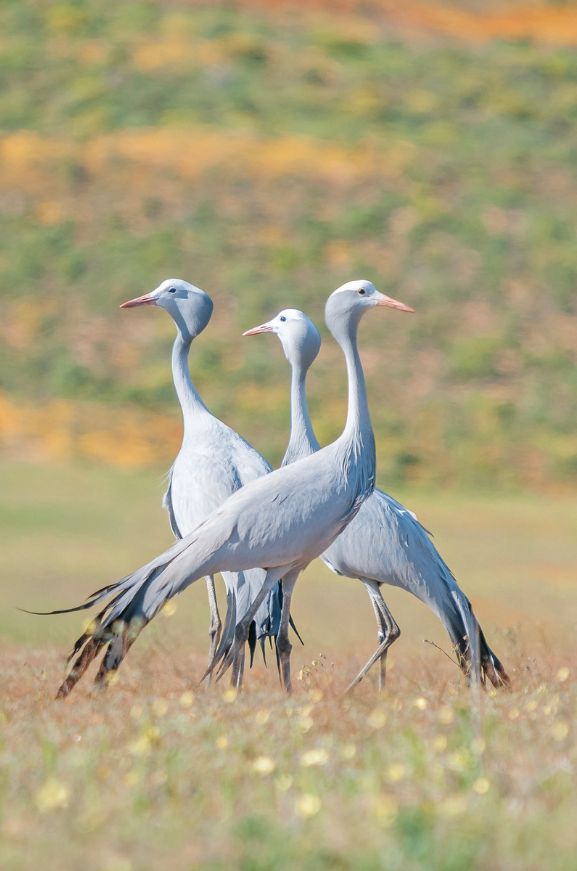
This change reflects growing concern about the species’ future – and it underscores the critical role of the Overberg region in the renewed effort to protect these elegant birds.
Data from the long-running Coordinated Avian Roadcounts (CAR) shows that the Overberg has seen an alarming 44% decline in Blue Crane numbers between 2011 and 2025. These figures, collated and shared by Dr Christie Craig of the Endangered Wildlife Trust/International Crane Foundation (EWT/ICF), a partner of the Overberg Crane Group (OCG), are particularly concerning given that this region supports more than half of the country’s remaining Blue Crane population.
The Red Data Book of Birds of South Africa is a comprehensive scientific assessment of the conservation status of bird species, identifying those most at risk of extinction. Compiled by BirdLife South Africa in partnership with the South African National Biodiversity Institute (SANBI) and expert organisations, such as the OCG and the EWT/ICF, the Red Data Book now lists the Blue Crane as Vulnerable – meaning it faces a high risk of extinction in the wild in the medium-term future.
A suite of threats to Blue Cranes
The Overberg once had a thriving Blue Crane population, with numbers increasing by 261% between 1994 and 2010, as per CAR data. Since 1991, the OCG along with partners such as CapeNature and EWT/ICF have driven Blue Crane conservation efforts in the Overberg, engaging actively with landowners to raise awareness and ensure that farming and cranes coexist peacefully. These interventions worked so well that in the mid-2010s, the regional red list status was downlisted from Vulnerable to Near Threatened. However, at this time, these conservation efforts driven by conservation organisations were reduced, as a result of limited resources.
A suite of other threats have also emerged over the years. These include disturbance during the breeding season, collisions with powerlines, entanglement in farm fencing and baling twine and poisoning – often from substances intended for other species.
In addition, shifts in agricultural practices over the past decade, including minimum till and increased canola production, have altered the landscape, which might have reduced the availability of suitable feeding and breeding areas for cranes, although more research is needed.
Recent research by Dr Craig into the species’ long-term viability revealed that breeding success in the Overberg has halved over the past 10 years. On average, pairs now raise just 0.55 fledglings – far below what’s needed to sustain the population. MSc student, Michelle Bouwer found that the key drivers of nest failure in the Overberg are disturbance and high temperatures. This is concerning given that climate change models predict significant drying and warming in the Western Cape.
The vital role of farmers
This new listing makes it clear: the Overberg is central to the Blue Crane’s survival.
What’s more, it has demonstrated that this species is dependent on ongoing conservation efforts, especially as they occur almost entirely outside of protected areas.
Conservation success will depend on collective action – from landowners and farmers to local municipalities, researchers and town residents. Encouragingly, many farmers in the region have already embraced their role as custodians of these birds, showing that agricultural productivity and biodiversity conservation can go hand in hand. Their commitment forms the backbone of South Africa’s Blue Crane conservation efforts.
The CAR project itself is a remarkable example of citizen science in action. Conducted twice annually, these surveys rely on dedicated volunteers who count birds along fixed routes, creating one of the most robust long-term datasets for large terrestrial birds in the country. This data underpins vital conservation decisions – including the recent uplisting of the Blue Crane.
While the new Red Data Book status is a sobering call to action, it also provides momentum to strengthen existing work. By formally acknowledging the increased threat to Blue Cranes, the listing opens doors for more support – from policy changes to increased collaboration in farming with nature. Crucially, it shines a spotlight on regions like the Overberg, where urgent interventions can have the greatest impact on securing a future for our national bird.
What are we doing about it?
Blue Cranes have a strong association with agriculture across their range in South Africa, where they face several different threats. This means that to conserve them, we need to draw on many different types of expertise. With the help of the Conservation Planning Specialist Group, the EWT/ICF partnership coordinated a multistakeholder conservation planning process for Blue Crane. Several stakeholders put their best thinking together to co-create a conservation plan, including members from EWT/ICF, Overberg Crane Group, CapeNature, Wool Growers Association, Kogelberg Biosphere Wildlife Rescue and Training Centre, Ezemvelo KZN Wildlife, Eskom and Birdlife South Africa. This conservation plan specifies several actions that will be implemented in the coming years. Together we are confident that with coordinated conservation action we can turn the trend around for Blue Crane.
The Endangered Wildlife Trust and the Overberg Crane Group work in partnership to protect Blue Cranes in the Overberg. The EWT and the International Crane Foundation work together in furthering conservation of cranes and their habitats throughout Africa. We are grateful to Leiden Conservation Foundation, Nashville Zoo, Zoo Neuwied, Jacksonville Zoo and Gardens, Safari West, Indwe Risk Services and Wildlife World for supporting the Blue Crane Conservation Planning process and the work to date.